


Blog
Hard Anodized vs Non-Stick Cookware: Which Is Better?

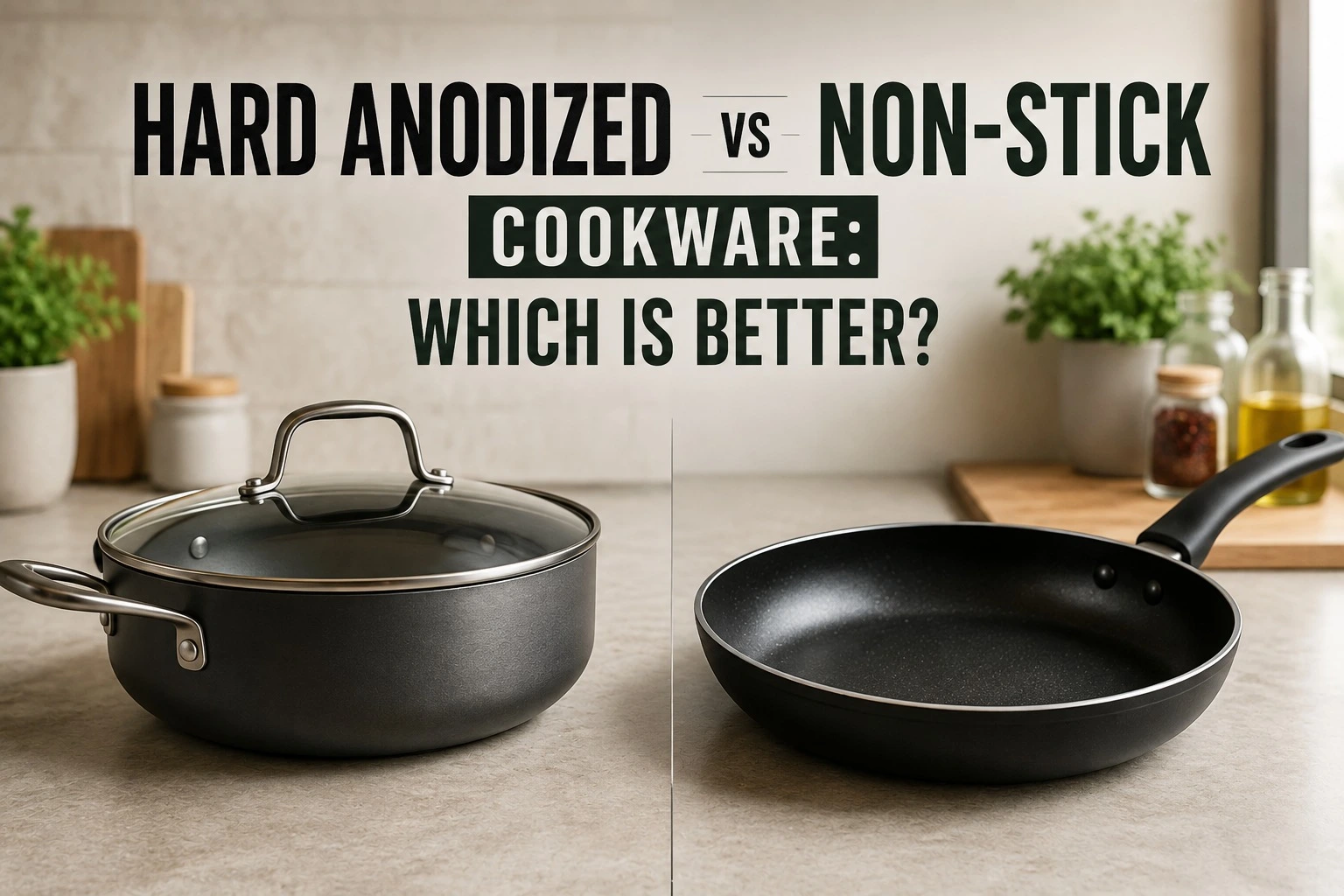
Choosing a cooking pan is about more than its appearance. The material can affect how food cooks, how much oil you need, how easily meals release from the surface, and how much care the pan requires over time.
Two options that often attract attention are hard anodized and non-stick cookware. They are designed differently, so each has its own strengths. Hard anodizing changes the surface of aluminum to create a harder oxide layer, while a non-stick coating is designed primarily to reduce food sticking.
Casio Cookwares offers both options, along with products that combine a hard anodized surface with non-stick performance. That makes the comparison particularly useful if you are deciding what will work best in your kitchen.
The better choice ultimately depends on how you cook, what you prepare most often, and which features matter most to you.
What Is Hard Anodized Cookware?
Hard anodized cookware starts with aluminum. The aluminum goes through an electrochemical anodizing process, which changes its surface and forms an anodic oxide layer.
Hardcoat anodizing is designed to create a harder and more abrasion-resistant finish. The Aluminum Anodizers Council explains that hardcoat anodized surfaces are used where hardness, wear resistance and durability are important, including cookware.
This makes the material a practical option for people who want a sturdy cooking surface for regular use.
Casio Cookwares has a dedicated Anodized category. Its current range includes products such as the Casio Anodized Casserole, Casio Anodized Frypan and Casio Anodized Sauce Pan.
Explore Casio’s Anodized Cookware Range
What makes the anodized surface different?
Anodizing is not simply paint placed over aluminum. It is a surface treatment that creates an anodic oxide finish as part of the aluminum’s surface.
A hard anodized surface can offer:
- Good abrasion resistance
- Corrosion resistance
- A harder surface than untreated aluminum
- Good heat-conducting characteristics from the aluminum body
- A durable option for regular cooking
It is worth remembering that hard anodized does not mean scratch-proof or indestructible. Proper handling and cleaning are still important.
What Is Non-Stick Cookware?
Non-stick cookware is designed to make food release more easily from the cooking surface.
Different products may use different coating technologies. Casio’s current range includes products described with PTFE coatings, as well as products marketed with marble-style non-stick surfaces.
The collection includes options such as the Casio Non-stick Milk Pan and Shenzhen Gift Pack Marble.
Explore Casio’s Non-Stick Cookware Range
The main benefit is convenience. When the surface is in good condition, food is less likely to stick firmly to it. This can be particularly helpful when preparing:
- Eggs and omelettes
- Pancakes
- Fish
- Delicate vegetables
- Other foods that can be difficult to release
For many home cooks, easier food release also means less time spent cleaning afterwards.
Hard Anodized vs Non-Stick: What’s the Difference?
The simplest distinction is the way the cooking surface is created.
Hard anodized: The aluminum surface is treated electrochemically to create an anodic oxide layer.
Non-stick: A specialized coating is used to reduce food adhesion.
However, the two are not necessarily separate choices.
Some cookware can use both technologies at the same time. Casio’s range includes products described as having a hard anodized surface alongside non-stick performance. Its WOK with G.L and Baking Disc (Tawa) are examples of this approach.
That means it is important to look at the construction of an individual product rather than assuming that every anodized pan and every non-stick pan is made in exactly the same way.
At a glance
| Feature | Hard Anodized | Non-Stick |
| Main advantage | Harder, abrasion-resistant surface | Easy food release |
| Food sticking | Depends on the surface and recipe | Generally low when the coating is in good condition |
| Surface durability | Strong abrasion resistance | Depends greatly on coating care |
| Low-oil cooking | Possible depending on the food | Particularly well suited to it |
| Cleaning | Generally straightforward | Usually very easy |
| Heat care | Follow product instructions | Heat control is especially important |
| Suitable for | Versatile everyday use | Delicate and low-stick foods |
| Can the technologies be combined? | Yes | Yes |
Which Option Is More Durable?
When surface durability is the main priority, hard anodized generally has an advantage.
Hardcoat anodizing is associated with hardness and resistance to abrasion. The Aluminum Anodizers Council describes hardcoat finishes as suitable for applications where wear resistance is important.
That does not mean every anodized product will last longer than every coated product. Construction, manufacturing quality, thickness, usage and maintenance all influence the life of a pan.
A coated surface can also perform very well when it is handled correctly. However, scratches, excessive heat and unsuitable cleaning can affect its performance.
Best for surface durability: Hard Anodized
If you cook frequently and want a robust aluminum surface, this option is worth considering.
Which Is Better for Low-Oil Cooking?
For foods where easy release is important, a good non-stick surface usually has the advantage.
Because food is less likely to adhere to the cooking surface, you can often prepare suitable dishes with little oil. This can be especially convenient for eggs, pancakes, fish and similar foods.
Hard anodized cookware can also be used with relatively little oil, depending on the food and the particular pan. It simply should not be assumed to provide exactly the same release characteristics as a dedicated non-stick surface.
Best for easy low-oil cooking: Non-Stick
If reducing sticking is one of your main concerns, this is usually the more convenient option.
Which Is Easier to Clean?
Both types can be straightforward to clean when they are maintained properly.
A non-stick surface generally has an advantage because food is less likely to stick firmly in the first place. That can reduce the need for scrubbing.
Hard anodized cookware can also be cleaned without much difficulty, but the correct cleaning method depends on the individual product.
For either type, aggressive scrubbing is best avoided unless the manufacturer specifically recommends it.
Best for quick cleanup: Non-Stick
If you want to spend less time cleaning after a meal, a good-quality non-stick surface can make a noticeable difference.
Which Is Better for Everyday Pakistani Cooking?
Pakistani kitchens often need cookware that can handle a wide range of meals. From sautéing onions and spices to preparing gravies, vegetables, eggs and flatbreads, different cooking tasks place different demands on a pan.
That is why there is no single surface that is perfect for every recipe.
Hard anodized can be useful for:
- Regular everyday cooking
- Sautéing
- Stir-frying
- Preparing sauces and gravies
- Cooking vegetables
- Pan and wok cooking
- Situations where surface durability matters
Casio’s anodized range includes a casserole, frypan, sauce pan and wok, giving shoppers several formats for everyday kitchen use.
Non-stick can be particularly useful for:
- Eggs
- Omelettes
- Pancakes
- Delicate foods
- Foods that tend to stick
- Low-oil recipes
- Quick cleanup
The practical answer may therefore be to use different pans for different jobs.
A frying pan with a non-stick surface can be useful for breakfast foods and delicate ingredients, while an anodized pan or wok can handle other everyday tasks.
Is Hard Anodized Cookware Safe?
Hard anodizing is an established treatment for aluminum and is used in cookware applications.
The Aluminum Anodizers Council explains that anodized aluminum is used for cookware and that anodizing produces a harder surface than untreated aluminum.
That said, cookware should always be used and cleaned according to the manufacturer’s instructions. Material safety should not be confused with claims that one type of cookware is automatically “healthier” than another.
The benefits of hard anodizing are primarily related to the properties of the treated aluminum surface, including its hardness and resistance to wear.
Is Non-Stick Cookware Safe?
Safety depends on the coating, manufacturing standards and how the cookware is used.
For PTFE-based surfaces, the U.S. Food and Drug Administration states that certain PFAS substances are authorized for specific food-contact applications, including non-stick cookware coatings. The FDA also reports negligible migration from approved polymerized coatings under the conditions evaluated.
That does not mean a non-stick pan should be deliberately overheated.
Good practice includes:
- Avoiding unnecessary extreme temperatures
- Not deliberately heating an empty pan for extended periods
- Following the manufacturer’s temperature guidance
- Using suitable utensils
- Replacing cookware when the cooking surface becomes severely damaged
Always follow the instructions supplied with your particular product.
How to Care for Hard Anodized Cookware
Even a durable surface benefits from sensible care.
Use appropriate utensils
Follow the manufacturer’s recommendations and avoid unnecessary scraping or rough handling.
Clean gently
Use suitable cleaning products and avoid aggressive scouring unless the product instructions allow it.
Avoid concentrated impact
Hard anodized surfaces are resistant to abrasion, but they are not immune to damage from concentrated force.
Follow the product instructions
Care requirements can differ between products. The instructions supplied with your specific cookware should take priority.
How to Care for Non-Stick Cookware
Non-stick surfaces generally need a little more attention.
Control the heat
Use the temperature recommended for your cookware and avoid unnecessarily high heat.
Do not deliberately overheat an empty pan
An empty pan can become hot quickly. Avoid leaving it on a burner without food or liquid.
Use suitable utensils
Wooden, silicone or other manufacturer-approved utensils can help protect the surface.
Avoid abrasive cleaning
If food remains on the pan, soaking it and cleaning gently is preferable to aggressive scraping.
Replace severely damaged cookware
If the cooking surface is badly damaged or no longer performs as intended, replacement is the sensible choice.
Which One Should You Choose?
Start with your cooking habits rather than simply choosing the material with the better-sounding name.
Hard Anodized May Suit You If You Want:
- A durable surface
- Good abrasion resistance
- Versatile everyday use
- An aluminum cooking surface with a hard anodized finish
- Cookware for regular cooking
Non-Stick May Suit You If You Want:
- Easy food release
- Low-oil cooking
- Convenient preparation of eggs and delicate foods
- Less sticking
- Easy cleanup
What if you want both?
You do not have to choose only one type.
Using different cookware for different tasks can be a practical approach. A non-stick frying pan can be reserved for delicate foods, while an anodized pan or wok can be used for other recipes.
There is also a third possibility: a product that combines hard anodized construction with a non-stick surface.
Casio Cookwares: Anodized and Non-Stick Options
Casio Cookwares currently has dedicated categories for both types.
Casio Anodized Range
The current Anodized category contains five listed products. The range includes options such as:
- Casio Anodized Casserole
- Casio Anodized Sauce Pan
- Casio Anodized Frypan
- Other anodized cookware options
Casio describes its anodized casserole as strong, suitable for daily cooking and designed for even heat distribution.
Casio Non-Stick Range
Casio’s current Non-Stick category contains 28 listed products, including:
- Casio Non-stick Milk Pan
- Shenzhen Gift Pack Marble
- Italia Gift Set PTFE Coating
- Charming Gift Set PTFE Coating
- Other cookware and gift sets
Products That Combine Both Technologies
One detail worth checking when shopping is the construction of the individual product.
Casio lists products that combine hard anodized aluminum or a hard anodized surface with non-stick performance. The WOK with G.L and Baking Disc (Tawa) are examples.
This gives shoppers another option when they want characteristics associated with both surface technologies.
Explore the Complete Casio Cookware Range
Frequently Asked Questions
Is hard anodized better than non-stick?
Neither is universally better. Hard anodized is generally more appealing when surface durability and abrasion resistance are priorities, while a non-stick surface is more convenient when easy food release and low-oil cooking matter most.
Is hard anodized the same as non-stick?
No. Anodizing is an electrochemical treatment of aluminum, whereas non-stick cookware relies on a coating designed to reduce food sticking.
Some products can combine both technologies.
Can hard anodized cookware also have a non-stick surface?
Yes. Casio currently lists products that combine hard anodized aluminum or a hard anodized surface with non-stick performance.
Which is better for eggs?
A good non-stick surface is usually the more convenient choice because eggs can release easily when the surface is in good condition.
Which is better for low-oil cooking?
A non-stick surface generally has the advantage because reducing food adhesion is one of its main purposes.
Which lasts longer?
There is no universal lifespan. Hard anodized surfaces are designed for good abrasion resistance, but the actual life of a product depends on its construction, quality, frequency of use and maintenance.
Is PTFE the same as PFOA?
No. PTFE and PFOA are different substances. PTFE is a fluoropolymer used in many non-stick applications, while PFOA is a separate chemical.
Can non-stick cookware be overheated?
It should not be deliberately overheated. Follow the manufacturer’s temperature recommendations and avoid unnecessarily heating an empty pan.
Is hard anodized suitable for everyday cooking?
Yes. Hard anodized aluminum is used in cookware, and Casio describes its anodized cookware as suitable for daily cooking.
Should I buy hard anodized or non-stick cookware?
Consider hard anodized if durability is your main concern. Choose non-stick if easy food release, low-oil cooking and convenience are more important. For a varied kitchen, having both can be practical.
Final Verdict: Hard Anodized or Non-Stick?
There is no universal winner.
Hard anodized is a strong option when durability, abrasion resistance and everyday versatility are important.
Non-stick is a strong option when easy food release, low-oil cooking and convenient cleanup are your priorities.
And there is another possibility: cookware that combines a hard anodized surface or aluminum body with non-stick performance.
Casio Cookwares offers dedicated anodized and non-stick ranges, along with products that bring these characteristics together.
So instead of asking which material is always better, think about the food you prepare and the way you use your cookware.
If you regularly make eggs, pancakes or other delicate foods, a non-stick pan can make cooking easier. If you want a durable option for a broader range of everyday cooking, hard anodized cookware may be a better fit. And if you want characteristics of both, Casio’s combination products are worth exploring.


