


Blog
Non-Stick Cookware Buying Guide for Pakistani Kitchens

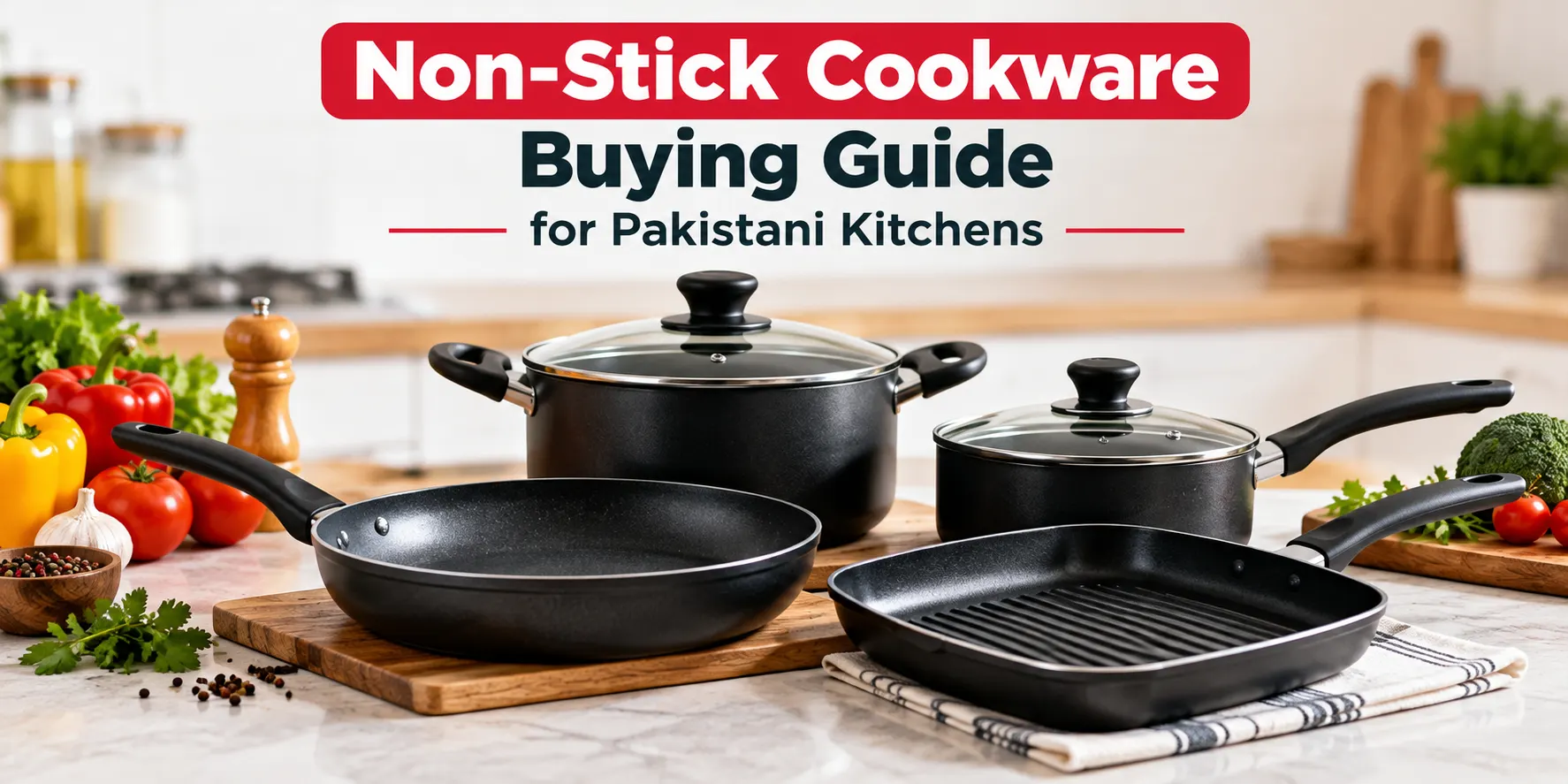
Non-stick cookware is a popular choice for everyday cooking, but buying the right set or pan requires more thought than simply choosing a design you like.
Pakistani kitchens handle everything from breakfast eggs and parathas to curries, sauces, fried foods and family dinners. The cookware you choose should therefore match the dishes you prepare, your family size, stove type and daily cooking habits.
This non-stick cookware buying guide for Pakistani kitchens will help you understand what to look for before buying, including cookware type, size, coating, handles, sets and care requirements.
If you’re ready to compare options, explore the Casio Non-Stick Cookware collection for available pans, tawa and cookware sets.
Start With What You Actually Cook
Don’t begin by asking, “Which is the biggest cookware set?”
Ask:
What do I cook most often?
A household regularly making roti and paratha has different requirements from someone who mainly needs a frying pan for breakfast. Similarly, a family setting up a complete kitchen may benefit from a cookware set, while an established kitchen may only need one replacement pan.
Before shopping, consider:
- your most frequently prepared dishes;
- number of people you normally cook for;
- whether you need individual pans or a complete set;
- available storage space;
- your stove or cooktop; and
- how much maintenance you’re comfortable with.
This prevents you from paying for cookware that spends most of its life inside a cabinet.
Which Non-Stick Cookware Pieces Do You Need?
Different cookware shapes perform different jobs. A useful kitchen doesn’t necessarily need every available type.
Fry Pan – The Everyday Essential
A non-stick fry pan is useful for eggs, omelettes, pancakes, shallow frying, sautéing and many everyday meals.
Casio’s Shenzhen range currently includes fry pans from 18 cm to 28cm, giving shoppers several sizes to choose from.
Smaller pans can be practical for lighter portions, while larger diameters provide more cooking surface for family-sized preparation.
Tawa – Important for Pakistani Kitchens
If roti, chapati or paratha regularly appears on your table, a tawa deserves separate consideration.
Casio currently lists a 30cm non-stick tawa within its non-stick range.
Instead of trying to make one frying pan perform every kitchen task, choosing cookware designed around your regular dishes can make your collection more practical.
SaucePan – More Than Just Sauce
A sauce pan can be useful for gravies, soups, smaller curries and other everyday preparation.
Casio’s Shenzhen Sauce Pan range currently provides 18cm, 20 cm and 22 cm options.
Choose according to the quantity you normally prepare rather than automatically buying the largest size.
Milk Pan – Useful for Smaller Jobs
A compact milk pan can be convenient for heating smaller quantities and quick kitchen tasks.
Casio’s current Shenzhen collection includes 15cm, 18cm and 20cm milk pans.
Grill Pan and Hotplate
These are more specialized pieces. Buy them when they match something you genuinely cook rather than simply because you want a larger cookware collection.
How Do You Choose the Right Pan Size?
One of the most common cookware-buying mistakes is ignoring size.
A very small frying pan can become frustrating when cooking for several people, while an oversized pan may be unnecessary for someone preparing single portions.
Think in terms of cooking surface + normal portion size.
For example, Casio’s current fry pan range extends from compact 18cm models through to 28cm options. Rather than assuming bigger means better, consider how much food you usually prepare and how much stovetop and storage space you have.
If pan sizing is confusing, our upcoming 18cm vs 20cm vs 24cm vs 28cm Fry Pan: Which Size Do You Need? guide will provide a more detailed comparison.
Individual Pans or a Complete Cookware Set?
This decision can significantly affect how much you spend.
Buy Individual Cookware When…
Your kitchen is already mostly equipped and you’re replacing specific items.
Perhaps your old fry pan needs replacing, or you want to add a dedicated tawa. In this situation, purchasing a 15- or 16-piece set may give you several pieces you don’t actually need.
Consider a Cookware Set When…
You’re setting up a new kitchen, replacing several old pieces at once or want coordinated cookware for different cooking tasks.
Casio’s non-stick ranges currently include multi-piece options such as Home Chef, Marina, Royal Palm and Sigma, alongside other cookware collections.
When comparing sets, don’t focus only on “15 pieces” versus “16 pieces.”
Check what those pieces actually are.
A smaller collection containing cookware you’ll use every week can provide more practical value than a larger set filled with pieces you rarely need.
Look Beyond the Words “Non-Stick”
Not every non-stick product should be assumed to have identical construction or coating.
Casio’s current product information, for example, identifies marble non-stick coatings on selected products, while specifications vary across ranges.
Before purchasing, check the individual product page for:
- Coating type: What surface does the specific product use?
- Construction: What is underneath that cooking surface?
- Thickness: Is thickness information provided for the model?
- Handles: How are they designed for normal use?
- Lids: If included, what type of lid comes with the cookware?
- Cooktop compatibility: Is the product suitable for your stove?
Avoid assuming that one feature applies to the entire non-stick category.
Check Your Stove Before Ordering
This becomes particularly important if you use an induction cooktop.
“Non-stick” describes the cooking surface; it does not automatically mean induction-compatible.
A non-stick pan may or may not work on induction depending on its base and construction.
Check the specifications of the exact cookware you’re considering.
If you use induction cooking, see our guide on How to Tell If Your Cookware Is Induction Compatible, or browse the Casio Induction Series for products intended for relevant induction cooking requirements.
Don’t Ignore the Handles and Lids
Most shoppers focus heavily on the cooking surface and barely look at anything else.
But you interact with the handle every time you use the pan.
Look at the handle design, positioning and product-specific information. For cookware sets with lids, check their construction as well.
Selected Casio non-stick sets are listed with tempered glass lids and heat-resistant/Bakelite handle designs, although specifications vary by range.
Always check the particular product rather than assuming every Casio pan or set uses the same components.
How to Protect Non-Stick Cookware
Buying good cookware is only half of the equation. How you use it matters too.
Follow the care instructions supplied with your specific cookware. In general, use utensils and cleaning tools appropriate for the non-stick surface and avoid abrasive treatment that could damage the coating.
Allow cookware to cool appropriately before cleaning and inspect the cooking surface and handles periodically.
If the coating becomes significantly damaged or the cookware shows other signs that could affect appropriate use, review the manufacturer’s guidance before continuing to use it.
For detailed maintenance advice, read How to Use Non-Stick Cookware Properly and Make It Last Longer and How to Clean Non-Stick Pans Without Damaging the Coating.
What About Non-Stick Cookware Price in Pakistan?
Price should be considered, but it shouldn’t be the only factor deciding your purchase.
Non-stick cookware prices can differ according to:
- cookware type;
- diameter or capacity;
- construction;
- coating;
- number of pieces;
- series;
- design and included components.
Instead of relying on a static price table in an article, check the live Casio Non-Stick Cookware collection for current product options and prices.
Compare usefulness and specifications alongside price.
A cheaper pan you rarely use isn’t necessarily better value than a well-matched pan that becomes part of your daily cooking routine.
Your Final Non-Stick Cookware Checklist
Before clicking “Add to Cart,” ask yourself:
What will I cook in it?
Choose the cookware type around real dishes.
What size do I need?
Match the diameter to your normal portions.
Do I need one pan or a set?
Don’t pay for pieces you won’t use.
What coating and construction does it have?
Check the individual product specifications.
Will it work on my stove?
Especially important for induction users.
Can I care for it properly?
Correct utensils, cleaning and handling matter.
If you can answer all six questions confidently, you’re much closer to making the right purchase.
Frequently Asked Questions
Which non-stick cookware is best for a Pakistani kitchen?
There isn’t one option that’s best for every household. Consider the dishes you regularly prepare, family size, stove type and whether you need a fry pan, tawa, sauce pan or complete set.
What size non-stick fry pan should I buy?
Choose according to your usual portions and cooking surface requirements. Casio’s Shenzhen range currently includes fry pans from 18cm through 28cm.
Should I buy a complete non-stick cookware set?
A complete set can make sense when setting up a new kitchen or replacing several pieces. If you only need one or two items, buying individual cookware may be more practical.
Is every non-stick pan induction compatible?
No. A non-stick cooking surface does not automatically make cookware suitable for induction. Check the base and product specifications for compatibility.
How can I make non-stick cookware last longer?
Follow the product’s care instructions, use suitable utensils and non-abrasive cleaning tools, and avoid treatment that could damage the cooking surface.
Build Your Kitchen Around the Way You Cook
The right non-stick cookware isn’t determined by the biggest set, fanciest design or lowest price.
It should fit your recipes, portions, stove and everyday cooking routine.
Casio Cookwares offers individual fry pans, sauce pans, milk pans, tawa and multi-piece non-stick collections, allowing you to build your kitchen around what you’ll actually use.
Ready to compare your options?


